When mobile app teams search for smart link tools, they often discover dozens of products that appear to do the same thing. Some focus on app downloads. Some focus on attribution. Some focus on deep linking. Others focus on social media traffic. The challenge is not finding a smart link tool. The challenge is choosing the right type of smart link for the stage your app is currently in.
A startup trying to get its first thousand installs has very different needs from a mature app running global acquisition campaigns. Understanding these differences can save time, money, and engineering effort.
Most App Teams Are Solving Different Problems
The phrase “smart link” means different things depending on who you ask. A growth marketer may think about campaign tracking. A mobile developer may think about deep linking. A product manager may think about onboarding flows. In practice, smart links usually fall into three categories: app routing links, deep links, and attribution links.
The mistake many teams make is choosing an enterprise solution before they have clearly identified which problem needs solving.
Smart App Routing Is the Most Common Use Case
For most mobile apps, the biggest challenge is getting users to the correct app store. Someone clicks a link from Instagram, TikTok, YouTube, a QR code, or an email campaign. The user should arrive at the App Store if they are on iPhone and Google Play if they are on Android.
This sounds simple, but many teams still share separate store links or send visitors to a generic landing page. Smart app routing removes that friction and creates a cleaner download experience.
Different Types of Smart Link Tools
Not every smart link platform serves the same purpose.
| Smart Link Type | Primary Goal | Best For |
|---|---|---|
| App Routing | App downloads | Acquisition campaigns |
| Deep Linking | In-app navigation | Existing users |
| Attribution Links | Marketing measurement | Growth teams |
| Link-in-Bio Links | Social traffic | Creators and brands |
| QR Smart Links | Offline campaigns | Events and print marketing |
Understanding these categories makes it easier to choose a platform that fits your goals instead of paying for features you may never use.
Why App Download Campaigns Need Smart Routing
Many app campaigns fail because users encounter unnecessary decisions. A social media visitor clicks a link and sees separate App Store and Google Play buttons. Some users choose the wrong option. Others abandon the process entirely.
Smart routing eliminates this step. The link automatically detects the user’s device and sends them to the correct destination. This creates a smoother experience and helps marketers maintain a single link across all campaigns.
Smart Links Become More Valuable as Channels Grow
The more marketing channels you use, the more valuable smart links become. A startup may begin with one Instagram profile, but later add TikTok, YouTube, newsletters, influencers, QR codes, and paid advertising. Managing separate store URLs across all these channels quickly becomes difficult.
A smart link creates consistency. Every campaign can use a clean destination while still allowing marketers to track traffic separately when needed.
Deep Linking and Smart Routing Are Not the Same Thing
Many marketers use the terms interchangeably, but they solve different problems. Smart routing focuses on helping users reach the correct store or destination. Deep linking focuses on taking users to a specific screen inside the app.
For example, a food delivery app may use smart routing to acquire new users and deep links to send existing users directly to a restaurant page. Most apps need both eventually, but acquisition usually comes first.
What Startups Should Look For
Most startups do not need enterprise-level attribution platforms on day one. Instead, they should focus on simplicity, reliability, and ease of implementation.
Useful features include:
- One link for both app stores
- Device detection
- Campaign tracking
- QR code compatibility
- Fast setup
- No SDK requirement
- Simple analytics
A smart link should reduce complexity, not introduce more of it.
Where OneRoute Fits
OneRoute from itlink.to focuses on one of the most common mobile app marketing problems: app downloads. Instead of sharing separate App Store and Google Play URLs, marketers can create one smart link that automatically routes users based on device.
This approach works well for social media bios, influencer campaigns, newsletters, paid ads, QR codes, and app launch promotions. Because marketers only need one link, campaigns become easier to manage while creating a cleaner experience for users.
When HubLink Makes More Sense
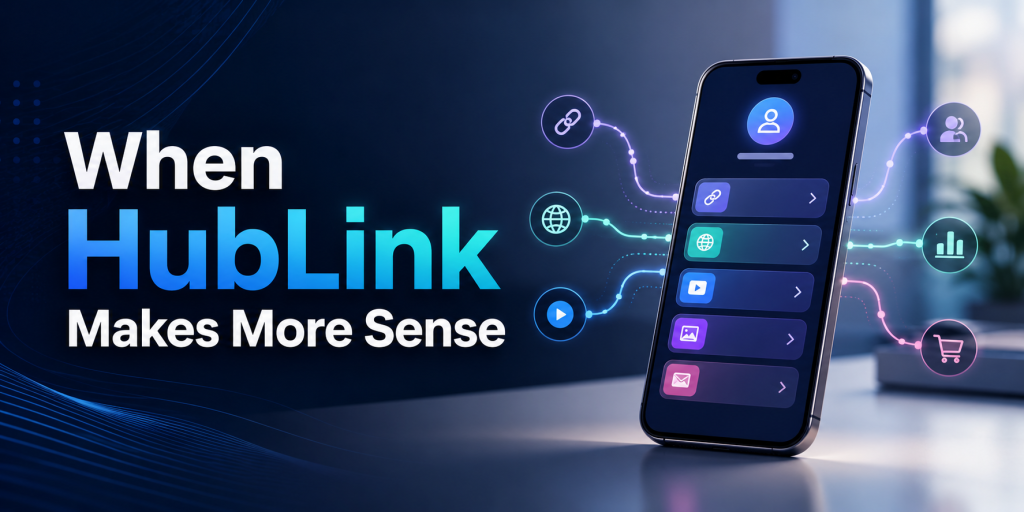
Sometimes visitors need more than an app download button. A startup may want to share its app, waitlist, pricing page, help center, investor deck, and social profiles from one destination. In these situations, a link-in-bio style solution is often more appropriate.
HubLink from itlink.to allows brands to create a single page that organizes multiple destinations. Many app companies use HubLink as their social profile destination while using OneRoute as the primary app download CTA inside that page.
Choosing the Best Smart Link Tool for Mobile Apps
The best smart link tools for mobile apps are not necessarily the most advanced. They are the tools that solve your current growth problem with the least amount of friction.
If your goal is increasing app installs, smart routing should be the priority. If your goal is improving in-app experiences, deep linking becomes more important. If your goal is measuring complex acquisition funnels, attribution tools may be worth exploring.
For many mobile apps in 2026, a combination of smart app routing and simple campaign tracking delivers the highest value. With free tools like OneRoute and HubLink from itlink.to, teams can improve app acquisition without investing in unnecessary complexity before they need it.
References
- Apple Developer — Supporting Universal Links in Your App Core architectural guide outlining the configuration of Universal Links to securely route inbound web traffic directly to specific, deep-linked views within native iOS applications.
- Android Developers — App Links Implementation Guide Google’s core platform documentation explaining how to build, verify, and deploy Android App Links to ensure reliable, non-ambiguous web-to-app routing behaviors.
- Google Analytics — Campaign URL Builder Official production utility designed to systematically append custom UTM parameters to destination paths to isolate and track specific marketing attribution traffic.